
AIM for Software teaches a practical, hands-on approach for using AI to develop better software specs and then using modern coding agents to generate working software from those specs.
Coding agents such as Claude Code and Codex have transformed software development. Prompt-based ("vibe") coding demonstrated that developers could build surprisingly sophisticated applications simply by describing the desired application in natural language.
While remarkably powerful, vibe coding also revealed an important limitation. As applications grew larger and more complex, success depended less on clever prompts and more on giving the coding agent a complete, consistent spec.
Spec/vibe-based coding builds on the strengths of vibe coding while overcoming many of its limitations. By combining the speed and creativity of vibe coding with a lightweight software spec, developers can produce more capable, reliable, and maintainable applications.
The AIM layered specification structure shown below provides a roadmap for developing complete software specs that guide modern coding agents.
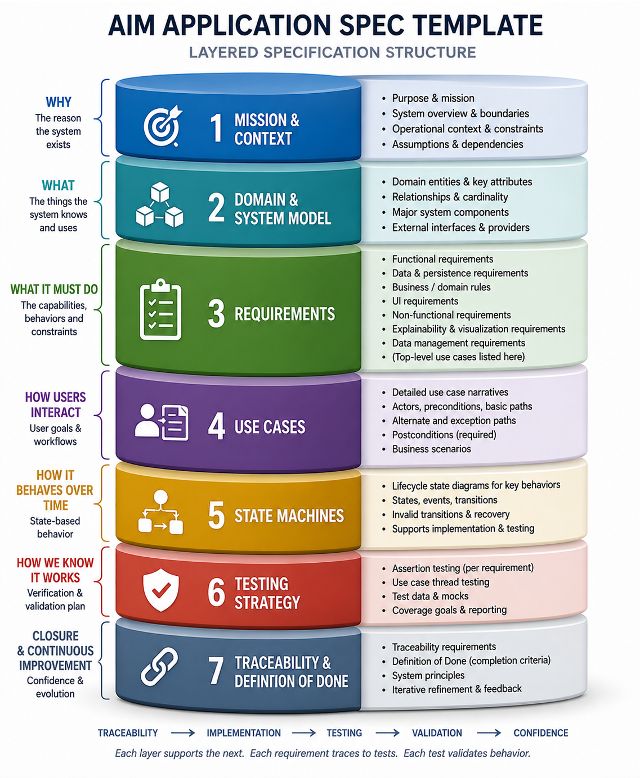
What kind of spec do coding agents work best from? It turns out they need the same kind of well-formed spec that helps human developers build the right software: clear requirements, use case narratives, a shared domain model or glossary, interface and behavior details, and a testing strategy that explains how the system should be verified. AIM organizes those elements into a lightweight layered structure so the coding agent is not just responding to prompts, but building from a coherent description of the software to be generated.
As most of the world knows by now, one of the biggest practical issues with vibe coding is token cost, which can literally run into billions of dollars. Repeated rebuilds can burn through tokens quickly, especially when the coding agent is still trying to infer intent, structure, behavior, tests, and edge cases from an incomplete description.
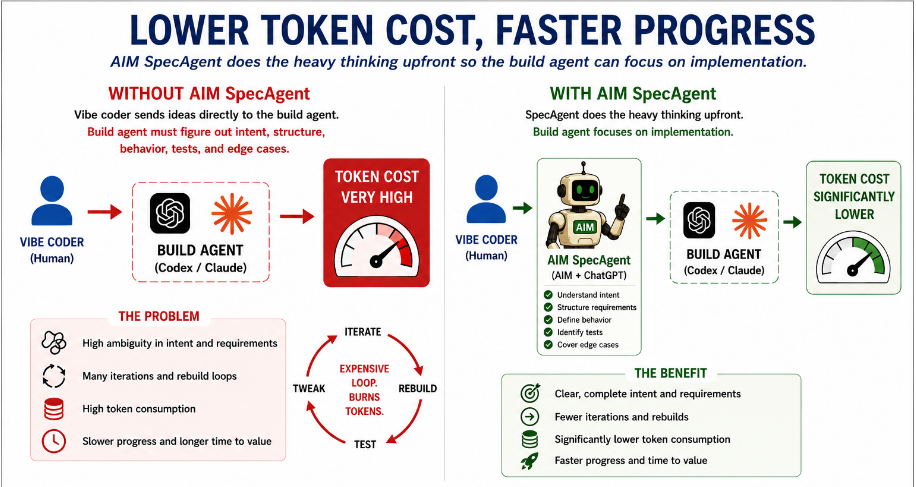
One of the biggest costs of vibe coding is iteration. As applications become larger and more complex, developers often find themselves asking the coding agent to regenerate portions of the application over and over again as missing requirements and misunderstandings are discovered. Too often, requirements get discovered by accident as you bump into them during development. Each iteration consumes additional time and tokens. As the conversation grows, so does the cost of generating the next version.
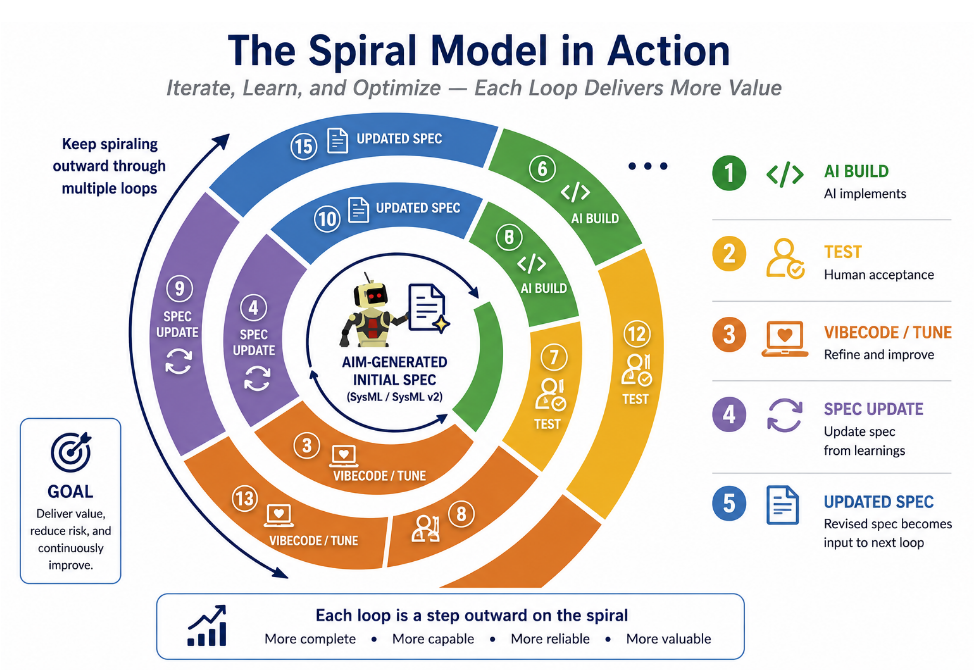
A good spec helps identify requirements before code generation begins, giving the coding agent a much clearer understanding of what to build. Fewer iterations mean lower token consumption, less debugging, and faster delivery of working software.
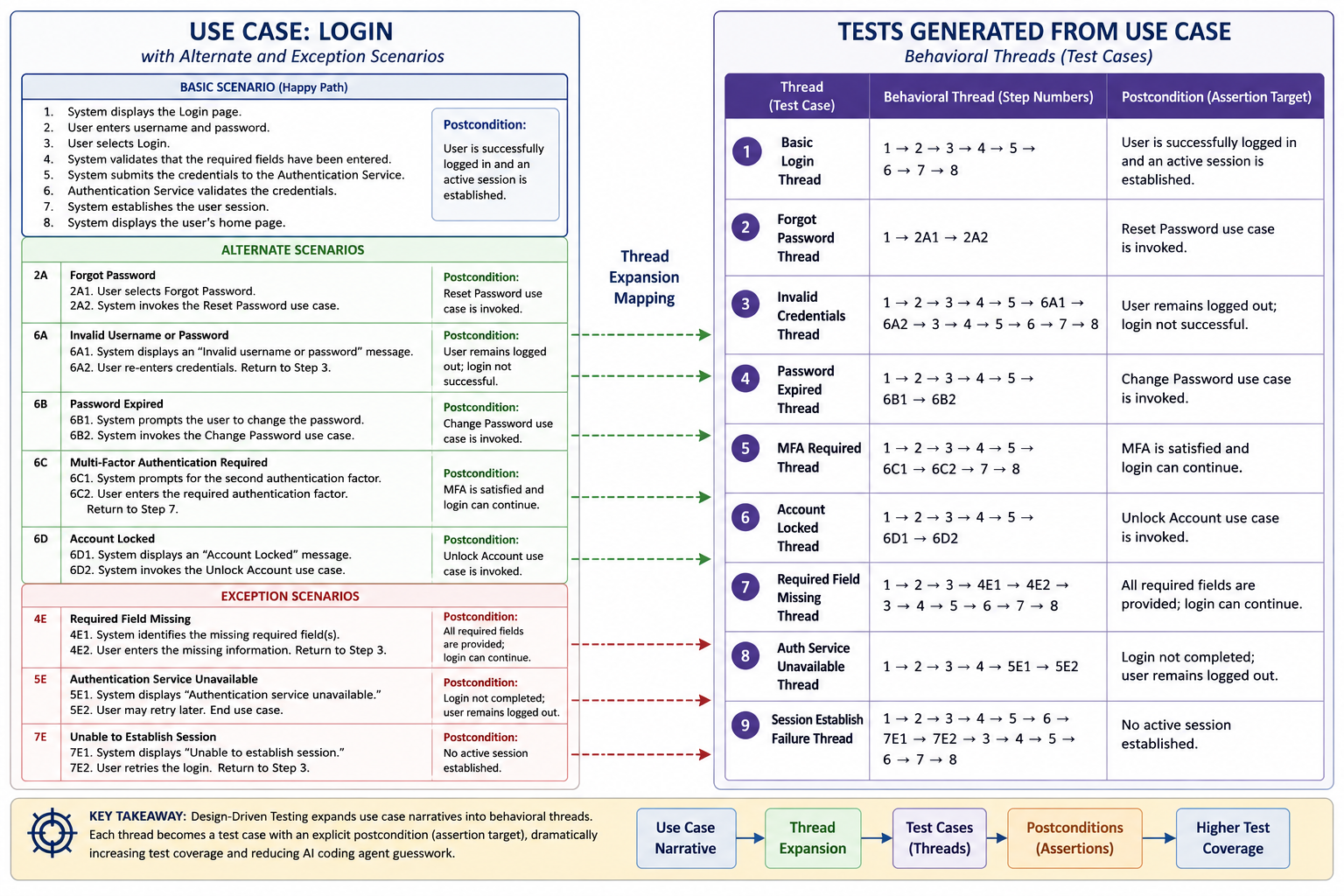
AI coding agents excel at implementing well-specified behavior but are forced to guess when requirements omit alternate and exception scenarios. AIM for Software applies Design-Driven Testing to systematically expand concise use case narratives into comprehensive behavioral threads. Each behavioral thread becomes a test case, and each scenario postcondition becomes the basis for an assertion. The result is higher functional test coverage, reduced ambiguity (guesswork) for coding agents, and more reliable software—all without requiring the expanded behavioral threads to become part of the specification. Instead, the coding agent can be instructed to apply the thread expansion strategy automatically during test generation.

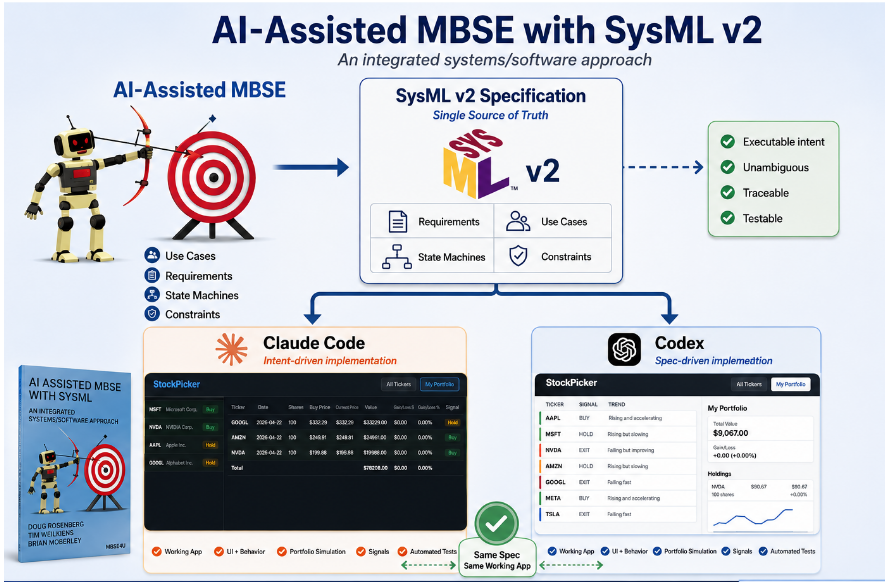
AIM for Software extends the principles of AI-Assisted MBSE (AIM) to software development. If you're new to AIM, learn more in the AI-Assisted MBSE (AIM) Training course. AIM uses AI to help develop system specs expressed in SysML v2. These specs include exactly the artifacts needed to spec software, including requirements, use case narratives, domain models, state machines, user interface specs, database design, and testing artifacts.
AI helps write the spec. The spec guides the coding agent, which writes the code.
Most of the effort shifts from repeated code generation to collaborative spec development with AI. Developing the spec can be done with general-purpose LLMs such as ChatGPT, while the coding agent focuses on what it does best—generating software from a well-defined spec.
The result is fewer iterations, software that's much closer to being right the first time, and dramatically lower token costs.
By the end of this course, you will be able to:
Duration: Two Days
Price: $1,295/student
Format: Instructor-led with extensive hands-on labs using ChatGPT and Codex (Claude Code may also be used).
Hands-On Workflow: Students develop a complete software spec with ChatGPT, then use that spec to generate, evaluate, and refine a working application with Codex or Claude Code.
Audience: Software developers, software architects, systems engineers, technical leads, and anyone interested in AI-assisted software development.
Prerequisites: Familiarity with software development concepts. No prior experience with AI coding agents or SysML v2 is required. Prior completion of the AI-Assisted MBSE (AIM) course is recommended, but not required.
